
Let's start with what you're actually afraid of
You're not afraid of the toy. You're afraid your partner will think you want them to stop touching you, that they're not enough, that you're critiquing what they do. And honestly? That fear is the exact opposite of what a lemon vibrator actually says.
Here's what we know from couples therapy: the biggest reason people never introduce toys into partnered sex is not resistance from partners. It's silence. The conversation never happens because one person is too nervous to start it. And that silence costs way more pleasure than any toy ever could.
So let's fix that.
The reframe that changes everything
Before we talk about what to say, you need to believe this: introducing a lemon clitoral vibrator is not a criticism of your partner. It's an expansion.
Think about it this way. Your partner's mouth, fingers, and body do incredible things. And they also have limits. No human can sustain the exact pressure and rhythm a suction-based tool can provide for as long as the tool can provide it. That's not a failure on your partner's part. That's just physics.
A lemon vibrator doesn't replace partnered touch. It adds a layer. Some people use it alone. Some use it during sex with a partner. Some couples use it as foreplay, then set it aside. The point is: you're not saying "you're not working." You're saying "here's something else I want to explore, and I want you here."
That distinction is everything. Carry it into the conversation.
How to actually start the conversation
Don't do it during sex. Don't do it right before sex. Don't do it in the dark.
Do it clothed, in daylight or good light, somewhere calm. A coffee shop, a walk, your living room on a random Thursday. The casualness of the setting tells your partner: this is not a crisis, it's just information.
Here's what works:
"I've been thinking about trying something new for my pleasure. I'm a little nervous to bring it up, so I'm just going to be direct. I want to explore using a clitoral vibrator during sex sometimes. I think it would feel really good, and I want to see what that's like together."
Notice what's in that sentence:
- You're owning your desire. "For my pleasure." Not "I read somewhere" or "I think you want me to." You.
- You're naming the vulnerability. "I'm nervous to bring it up." This humanizes you and makes your partner want to support you, not defend themselves.
- You're direct, not vague. Say the word. Clitoral vibrator. Not "something." Not "a toy." Not "this thing I read about."
- You're collaborative. "Together." Your partner is invited in, not told what's happening.
After you say that, stop talking. Let your partner respond. Don't fill the silence with apologies or explanations. Just wait.
What your partner might actually say (and what it means)
The best response: "Okay, I'm interested. Tell me more." This is rare, but when it happens, you're gold. They're curious.
The common response: "Really? Um, okay. I'm open to it." Translation: they're processing. They're not saying no, they're just adjusting. This is fine. Give them time.
The anxious response: "Does that mean I'm not doing something right?" This is the fear talking. Your job is to be very clear: "No. I love what we do. This is not about you. It's about me knowing myself better and wanting to share that with you." That's the truth. Stick to it.
The hesitant response: "I don't know. Can I think about it?" Absolutely. In fact, if they need time, that's healthy. Don't push. Circle back in a few days.
The resistant response: "No, I don't feel comfortable with that." Okay. This is a real conversation now. Ask why. Is it about their body image? Insecurity? A boundary they genuinely need? These are solvable problems, but only if you know what the actual problem is.
The three biggest objections and how to answer them
"Won't it feel like I'm being replaced?"
Not unless you make it feel that way. A lemon vibrator is not a partner substitute. It's a sensation you can't generate with hands and a mouth. You still need your partner's touch, presence, and energy. The vibrator just adds one specific thing. When you use it together, your partner is watching you, touching you elsewhere, or inside you. They're participating. They're not on the sideline.
"Will you finish faster without me?"
Maybe. And that's not a bad thing. But here's the real answer: sometimes yes, sometimes no. How to Find the Right Lemon Vibrator Intensity Setting for Your Body talks through this, but the short version is that using a clitoral vibrator doesn't mean you're rushing. It means you're using a tool that works better for your body in that moment. Your partner can use the time to enjoy the experience, try something new, or simply be present.
"What if I watch you use it and it doesn't turn me on?"
Then you've learned something useful. Not everyone is visually stimulated by their partner using a toy. Some people are. Some people are indifferent. Some people find it incredibly hot. There's no wrong answer. If your partner isn't turned on by it, that doesn't mean the experiment failed. It just means you move on and find something that works for both of you.
The first time you actually use it together
Don't make it weird by making it a production. You don't need to buy special lighting or set a scene. Just integrate it naturally into foreplay or sex, the same way you'd integrate anything else.
Let your partner stay in the lead. You guide their hand if they're nervous, or use it yourself while they're inside you or touching you elsewhere. The novelty will wear off fast. Once it does, it's just another tool in the toolkit.
If something feels off, pause. Adjust. Talk about it. There's no perfect first time. There's just the first time, and then you figure it out as you go.
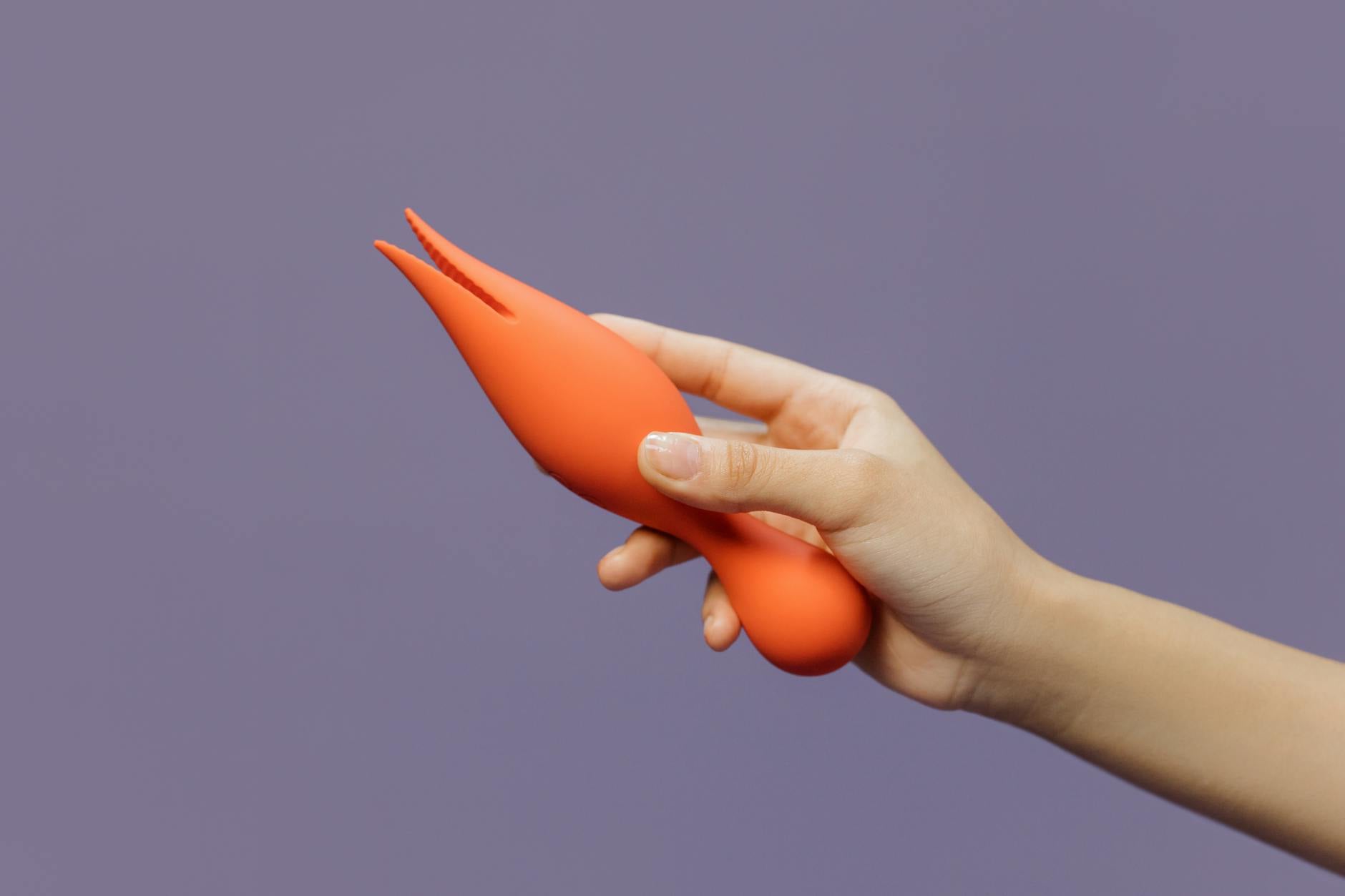
Photo by cottonbro studio on Pexels
Why couples actually bond over this
Here's what I've noticed in my practice: couples who can introduce toys or new desires without shame end up more connected, not less. Because the act of naming what you want, being vulnerable about it, and having your partner show up anyway is a kind of intimacy that regular sex doesn't always provide.
Your partner gets to see you unapologetically pursuing pleasure. You get to feel supported in wanting more. You both get to explore something new together instead of sneaking around with it solo.
That's the whole thing, really. It's not about the toy. It's about the conversation that lets you both be honest about what you want.
What happens when the conversation goes badly
Sometimes it does. Your partner might get defensive, withdraw, or say something that stings. If that happens, don't abandon ship. This is actually a couples communication issue, not a toy issue.
You might benefit from a couple's conversation framework or even a few sessions with someone who specializes in this. How Lemon Vibrators Reignite Desire When Arousal Feels Slower in Midlife approaches this from a different angle, but the real problem is that you and your partner need better tools to talk about desire together.
That's worth fixing, separately from whether or not you use a toy.
The post conversation conversation
After you've used a lemon clitoral vibrator together for the first time (or fifth time, or whenever it feels natural), circle back. Ask your partner what they thought. Ask what felt good and what didn't. Listen without defending. Then tell them what worked for you.
This keeps the conversation open. It signals that this is normal, ongoing communication, not a one-time awkward request. And it usually makes the next conversation easier.
FAQ
What if my partner wants to use the lemon vibrator on me but I'm not sure I want that?
You can say no. You can also say "let me think about it" or "I'd rather try it solo first." Your comfort matters as much as theirs. If they push back, that's a separate problem. But most partners will respect your boundaries once they hear them clearly.
Is there an age where introducing toys becomes awkward?
Not really. How to Use a Lemon Clitoral Vibrator for the First Time Over 50 covers this in detail, but the short answer is: if you're old enough to want pleasure, you're old enough to ask for it. Age doesn't make vulnerability less important. It might even make it more important.
What if I want to use a lemon vibrator during partnered sex but my partner isn't interested?
You have options. You can use it solo. You can keep the conversation open and circle back in a few months. Or you can accept that this is a boundary for them and find other ways to explore pleasure together. None of these options means the relationship is broken.
Should I use a lemon vibrator with a new partner?
Timeline is personal. Some people introduce toys in week three. Some wait six months. There's no rule. But the conversation should come before the toy. Even in a brand new relationship, you can say: "I'm interested in exploring toys in partnered sex. How do you feel about that?" If they're not into it, you know early.
Can using a lemon vibrator make my partner's insecurity worse?
Possibly, if they already have insecurity and you introduce it badly. Which is why the conversation matters so much. If your partner understands that the vibrator is about you knowing your own body better, not about them being inadequate, the risk drops significantly. But if they're dealing with deeper self-worth issues, this might not be the right entry point. That might require separate conversation or support.
What if we use a lemon vibrator together and I orgasm faster than I usually do?
Then you've learned that your body responds really well to clitoral suction stimulation. That's valuable information. Some partners find this incredibly hot. Some feel like they've been replaced. This is where post-conversation communication matters. You're not obligated to apologize for pleasure. But you can reassure your partner that the speed of the orgasm doesn't diminish the experience of being together.
Bringing a clitoral vibrator into your partnered sex life doesn't have to be complicated. It's just a conversation, some honesty, and permission to explore. Start there. The rest usually follows.